In short
- Solar pays on most warehouses in Australia: the load runs in daylight, and the roof is big enough for whatever the load needs.
- The roof is rarely the limit. The limit is how much of the power the site uses itself, and what the network lets you export.
- A five-day site sends weekend solar to the grid for a small credit. Size to the weekday load and the weekend takes care of itself.
Yes, solar usually saves a warehouse real money, because the site runs when the sun is up. Lighting, forklift charging, conveyors, offices and any cool room all draw power through the day, so a well-sized system is mostly used on site. The question on a warehouse is never whether the roof is big enough. It almost always is. The question is how much of the solar the site will use, and that is set by the hours it keeps.
| Quick facts | Solar for a warehouse |
|---|---|
| Share of solar used on site | about 75–80% on a six-day site, less on five days |
| Part of the bill solar can cut | daytime energy; the demand charge only if the peak is at midday |
| What usually limits the system | the network's export limit, not the roof |
| What to send | one recent bill; we get the interval data from it |
| Leased building | the roof owner signs; the saving goes to whoever pays the bill |
Why does solar suit a warehouse?
Three things work in a warehouse's favour.
- The load is in daylight. Picking, packing and dispatch run on day shifts, so the site is drawing power at the same hours the panels make it.
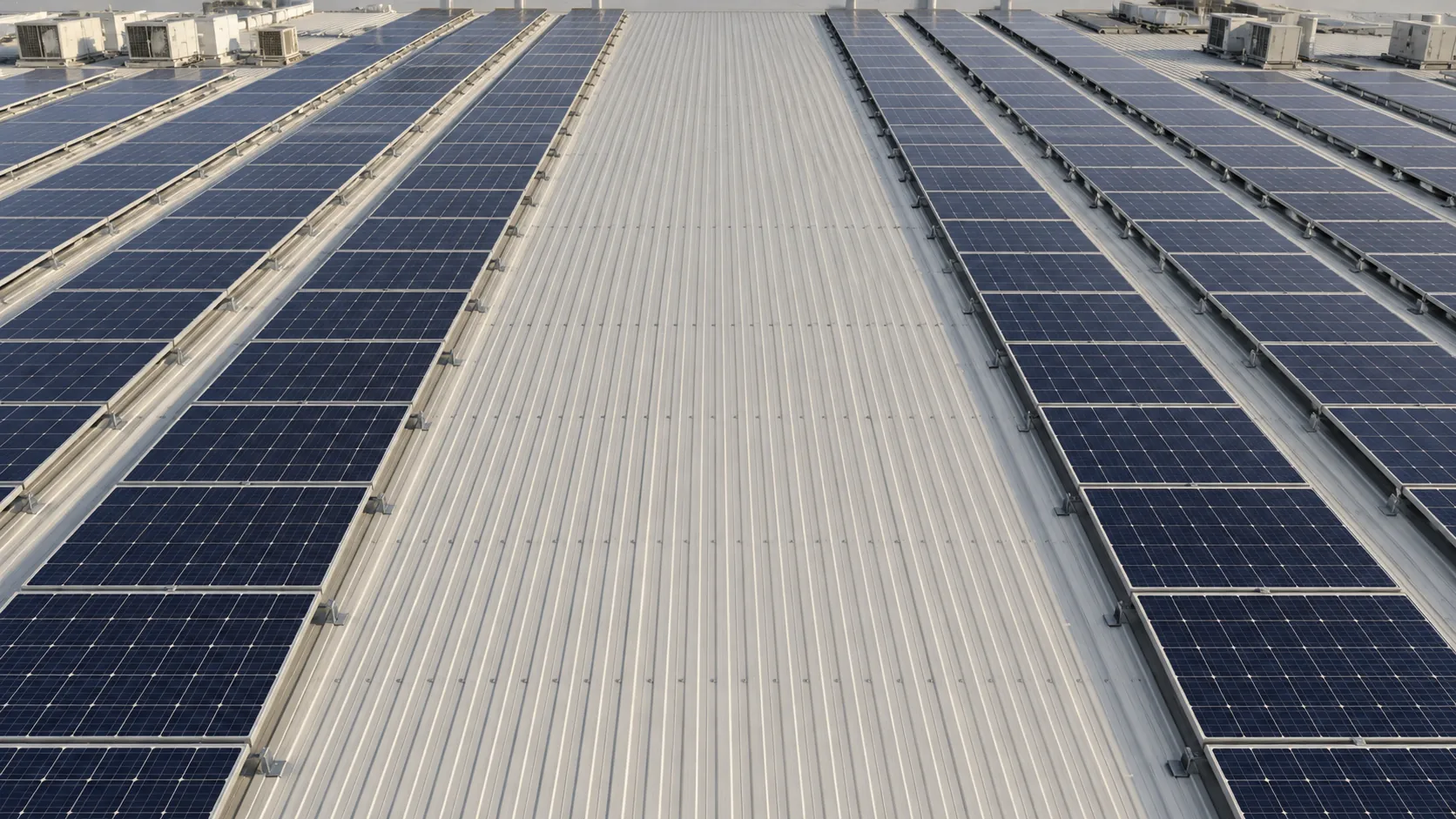
- The roof is large and simple. A long, low-pitched metal roof fits a big system without the structural work a smaller or older building needs.
- The load is spread out. Lighting, forklift chargers and a cool room or two run steadily rather than in short bursts, so the panels cover a broad load rather than a spike.
The catch is the weekend. A warehouse that closes on Saturday and Sunday makes two days of solar a week that nobody is there to use. That power goes to the grid for a few cents, if the network allows it at all.
How much will solar save a warehouse?
Here is a worked example with made-up figures. These are example figures, not our prices or a real site. They match the warehouse row on commercial solar cost.
A Brisbane warehouse runs day shifts six days a week. It puts in a 100kW system, which makes about 145,000 kWh a year.
- The site uses about 78% of the solar itself, about 113,000 kWh. The rest goes to the grid on Sundays and at the midday peak.
- At $0.28 for each kWh it no longer buys and $0.05 for what goes to the grid: 113,100 kWh × $0.28 = $31,668, plus 31,900 kWh × $0.05 = $1,595. Yearly saving $33,263.
- At an example price of $73,000 after the STC discount, that pays back in about 2.2 years.
Two things move that answer more than anything else.
The rate you pay. A large site often pays less per kWh with a demand charge on top. At $0.20 a kWh the same system saves about $24,200 a year and pays back in about 3 years. The rate is on your bill, and it is the one figure a quote should never guess.
The days you run. Close the same site on Saturdays and self-use drops to around 65%. The saving becomes 94,250 kWh × $0.28 = $26,390, plus 50,750 kWh × $0.05 = $2,538, which is $28,928 a year and a payback of about 2.5 years. Still good, but a quote that assumed six days on a five-day site is a quarter of a year out.
Should a warehouse fill the roof?
Usually not. A 5,000 m² roof could hold a system far larger than most sites can use, and every kW past the daytime load makes power at the same hours as the first, when the site is already covered.
On the same example, doubling to 200kW makes about 290,000 kWh a year, but the site can only use about 50% of it. The saving rises to 145,000 kWh × $0.28 = $40,600, plus 145,000 kWh × $0.05 = $7,250, which is $47,850 a year. The second 100kW adds about $14,600 a year, well under half what the first 100kW earns, and it only does that if the network lets you export the rest.
Divide the extra price in your quote by that extra saving to see the second half's payback on its own. Often the right size is the one that covers the weekday load with a little over, not the one that fills the roof.
What about the export limit?
This is the question that catches warehouses out. Because the roof allows a big system, the network's rules decide how big a system can be, not the roof.
For a system over 30kW the network operator reviews the connection, and on many feeders it caps how much the site can send out, sometimes to zero. A zero-export system still works and still saves the site its own daytime use, but every kWh it can't use is wasted rather than credited. The connection application is lodged by the installer before anything is bought, and the quote should say who lodges it, how long it takes, and what the export limit is likely to be. A quote with no export figure has not been checked against the network.
Is a battery worth it on a warehouse?
Rarely for the weekend power. Two days of spare solar a week is too little to justify a battery that sits idle the other five. The better test is the demand charge. A warehouse sets its peak when the forklift chargers, the cool room compressor and the lighting all start at the same hour on a hot afternoon. If your interval data shows that peak is short and sharp, a battery that trims it can pay where storing weekend solar doesn't. See demand charges and commercial solar batteries.
Solar on a leased warehouse
Most warehouses are leased, and the roof belongs to the landlord while the bill belongs to the tenant. Solar still works, but someone has to own it.
- The tenant buys it. Works on a long lease. The tenant needs the landlord's written consent to the roof fixings, and the lease should say what happens to the system when the tenant leaves.
- The landlord buys it. The landlord owns the system and either raises the rent, sells the power to the tenant below the grid rate, or does both. The tenant saves, the landlord gets a return on the roof.
- Either way, the design uses the tenant's bill. The load is the tenant's, so the sizing comes from the tenant's interval data, whoever pays for the panels.
If you manage the building for an owner, say so on the form. The proposal then shows the return both ways.
What does each state offer a warehouse?
The federal STC discount applies everywhere. Since 1 October 2026 it covers eligible systems up to 1MW, and a system between 100kW and 1MW chooses between STCs and REGO certificates. The states add little for solar itself.
| State | What matters for a warehouse |
|---|---|
| NSW | No rebate on solar panels. The Peak Demand Reduction Scheme gives businesses an upfront discount on batteries from 20 kWh to 30 MWh, larger when new solar goes in within 90 days. For a warehouse with a sharp afternoon peak, this can change the battery answer. |
| VIC | Victorian Energy Upgrades gives an upfront discount on business solar systems between 30kW and 200kW, through an accredited provider. Most warehouse systems fall inside that range. |
| QLD | No state rebate for commercial solar. Feed-in credits in the south-east are set by retailers, so check your contract before counting on weekend exports. |
| SA | No state government rebate. Some councils, such as the City of Adelaide, run their own. Export value is especially weak, so size the system to what the site uses. |
| WA | No state rebate for business solar. The buyback scheme doesn't cover commercial systems, so the return comes from what the site uses. Export limits on larger systems are common. |
| ACT | No solar rebate. The Sustainable Business Program co-funds energy efficiency upgrades up to $10,000. Solar isn't a listed item. |
We haven't checked Tasmania or the Northern Territory yet, so nothing here applies to them. Full detail and dates are on commercial solar rebates.
What should a warehouse send for a proposal?
Just one recent bill, every page. Using the NMI on it, the team gets your interval data, which shows the weekday load, the weekend gap and when the peaks happen. You don't need to request anything.
If you know them, these help too. Mention them in the form:
- Operating days and hours: five or six days, and whether there's a night shift
- Forklifts: how many charge on site, and whether they charge overnight or on breaks
- Cool rooms: how many, and whether they run at weekends
- Who owns the building: owned, leased, or managed for the owner
Already have a quote? Compare it line by line with our checklist and we'll check the price per kW, the self-use share and the export assumption against your interval data, free.
What to ask your installer
- How much of the solar do you expect us to use, and is that from our interval data or an assumed figure?
- What does the system save at our real rate per kWh, not a typical one?
- What export limit have you assumed, and have you checked it with the network operator?
- What happens to the power we make on days we're closed?
- Is the roof sheeting and purlin spacing rated for the fixing you've specified, and who signs off on that?
- If we lease, what does the landlord need to sign, and what happens to the system at the end of the lease?
How much solar a warehouse can use is in its interval data, and only your bill shows the rate it saves. Send a bill and an accredited installer prepares a costed proposal sized to how your site uses power. It's free, with no obligation.