In short
- An Adelaide factory on day shifts should expect a commercial solar payback of around two to two and a half years in 2026, as long as the system is sized to what the plant uses and not to the roof.
- South Australia has the highest share of rooftop solar in the country, so midday exports are worth very little; the value is in offsetting what you would otherwise buy.
- One distributor, SA Power Networks, covers the state, and commercial-sized systems must be dynamic-export capable.
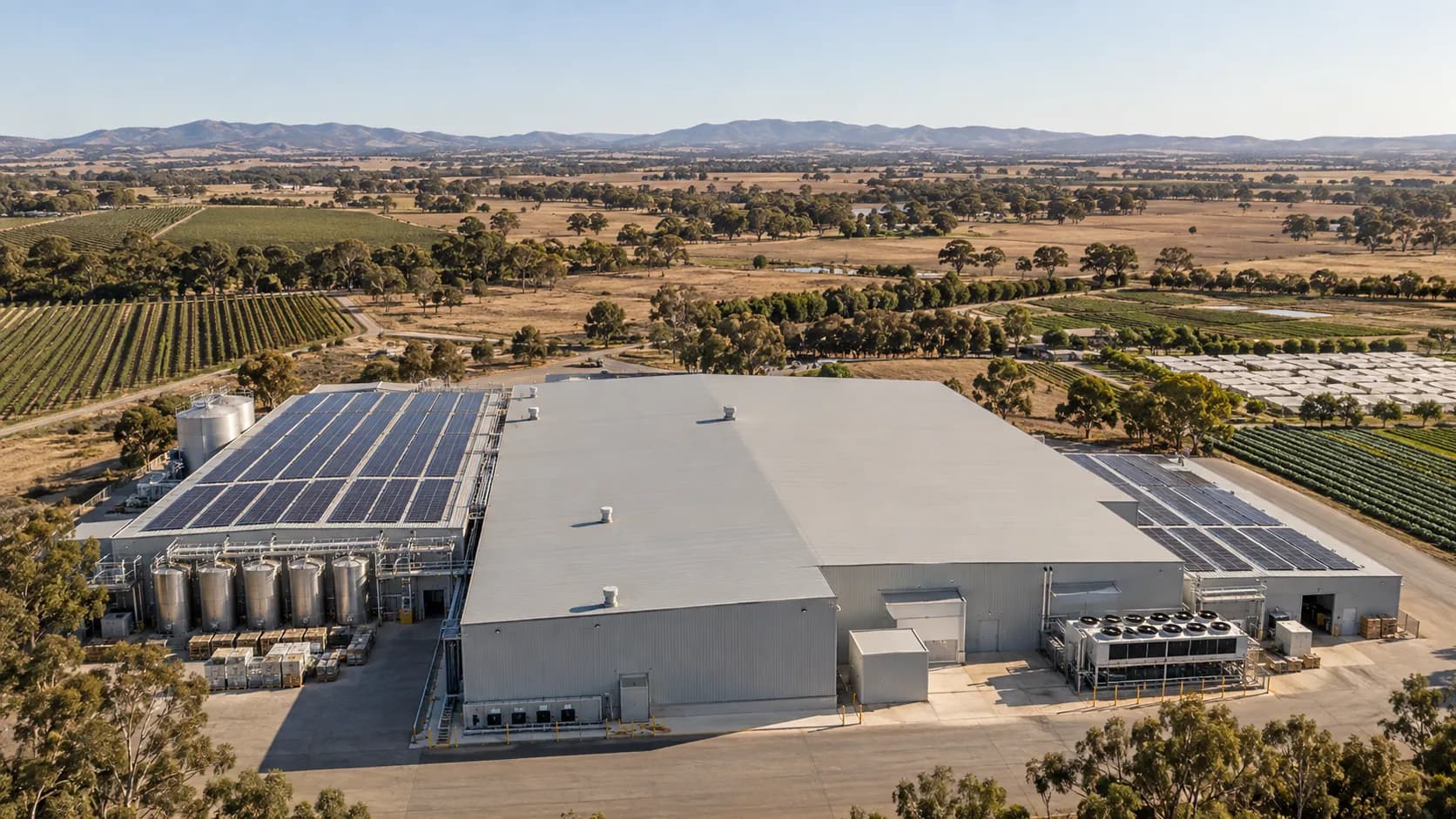
For an Adelaide manufacturer, commercial solar in 2026 pays back in roughly two to two and a half years on a weekday-shift site, provided the system is sized to the factory's own daytime load. Oversize it and the surplus goes to a grid that already has more midday solar than it can use. This page covers what is specific to Adelaide. The shift-pattern sums, the 1 MW STC change and the tax position are on solar for manufacturing, and the city as a whole is on commercial solar Adelaide.
| Quick facts | Manufacturing solar in Adelaide |
|---|---|
| Network | SA Power Networks, statewide |
| STC zone | Zone 3, rating 1.382 |
| State incentive | None from the state; City of Adelaide council scheme for sites in its area |
| Example payback | 2.1 to 2.6 years at 100kW, with exports at zero |
| What to send | one recent bill; we get the interval data from it |
What's different in Adelaide
1. One network, and dynamic exports
SA Power Networks covers the whole state, which makes Adelaide the most straightforward connection of the capitals: one set of thresholds and one process whether the factory is at Wingfield, Edinburgh, Lonsdale or Regency Park. The distinctive rule is dynamic export: new and upgraded systems up to 200 kVA of export must be dynamic-export capable, so the network can lower the export limit remotely when the grid is congested. It has applied to commercial-sized systems since 1 July 2024, and a competent installer builds for it.
- Up to 30 kVA: the small embedded generation process.
- Around 100kW: the medium process, with dynamic-export capability required. The proposal should say who applies and how long it takes.
- Above 100kW: still within the medium band up to 200 kVA of export; beyond that a negotiated connection. Since 1 October 2026 a 100kW to 1MW system can take the upfront STC discount (mid-scale rules), but in Adelaide a larger system only pays if the plant uses the output, because the export it would otherwise earn is close to nothing.
2. The STC zone: Zone 3
Adelaide postcodes sit in STC Zone 3, rating 1.382. A 100kW system installed in 2026 earns 100 × 1.382 × 5 = 691 certificates, the same as Sydney and Brisbane and more than Melbourne see the postcode zone table on the Clean Energy Regulator page.
3. No state rebate; a council scheme in the city centre
The South Australian government has no commercial solar rebate (energy.gov.au, South Australian business rebates). If the site is inside the City of Adelaide council area, its Sustainability Incentives Scheme lists business and commercial solar among what it can rebate; most factories are outside that boundary, in the northern and western suburbs. What South Australia does have is the national record for rooftop solar, and that changes the economics rather than the incentives: midday wholesale prices are frequently at or below zero, so exports earn very little and a proposal that relies on export income is not one to trust.
4. Adelaide's factories
General knowledge, not a measurement: Adelaide's manufacturing sits in the north (Edinburgh, Elizabeth, Wingfield, Regency Park, Pooraka), the west (Royal Park, Port Adelaide) and the south (Lonsdale), with defence, food and wine processing, metal fabrication and medical devices well represented. Sites are three-phase with a demand charge. Summer afternoons bring a cooling load that lines up well with solar; the peak that sets the demand charge is often at start-up or on a hot afternoon after 4pm, which solar misses. See demand charges.
What payback should an Adelaide factory expect?
Here is a worked example with example figures. They are not our prices and not a real site.
A 100kW system in Adelaide is assumed to make about 1,450 kWh per kW a year, so 145,000 kWh in total. Each kWh the factory uses itself saves $0.28. Each kWh sent to the grid earns $0.00. The example price is $73,000 after the STC discount, the figure used on commercial solar cost.
| Shift pattern | Solar used on site | Saved on purchases | Earned on exports | Yearly saving | Years to pay back |
|---|---|---|---|---|---|
| One weekday day shift, closed weekends | 70% | $28,420 | $0 | $28,420 | 2.6 |
| Two shifts, six days a week | 85% | $34,510 | $0 | $34,510 | 2.1 |
The sums: 145,000 kWh × 70% = 101,500 kWh used on site × $0.28 = $28,420, plus 43,500 kWh exported × $0.00 = $0. Total $28,420 a year, and $73,000 ÷ $28,420 = 2.6 years. The second row works the same way at 85%.
Exports are set to zero in this table on purpose. With South Australia's midday prices, that is the honest assumption for Adelaide. At $0.05 a kWh the one-shift payback shortens by about 0.2 of a year; at zero, a factory that only uses 70% of its output is paying for 30% it gets nothing for, which is the case for sizing down rather than up.
These sums leave out demand charges, the slow wear of panels and future price changes. The same table by site type is on commercial solar cost, and the full shift-pattern table is on solar for manufacturing.
What to send for an Adelaide manufacturing proposal
Just one recent electricity bill, with every page. The pages after the amount owing carry your tariff, your demand charge and your meter number. We use the meter number to get your interval data ourselves, so there is nothing to request from your retailer. In Adelaide the interval data matters more than anywhere, because the right system is the one that matches the plant's daytime draw and no larger. From there you get a costed proposal with export revenue shown separately, and the case tested with it set to zero.
If you already have a quote, compare it line by line with our checklist. Otherwise, send your bill.
Questions from Adelaide manufacturers
Why do you set export income to zero for Adelaide? Because South Australia has more rooftop solar per head than anywhere else, and in the middle of a sunny day wholesale prices are often at or below zero. A commercial contract may pay a few cents or nothing for exports, and the network can lower the export limit remotely under the dynamic export rules. A proposal that makes the payback look good on export income will disappoint. Run the case at zero and size to what the factory uses.
What is dynamic export and does my factory have to comply? Dynamic export lets SA Power Networks change a system's export limit remotely when the grid is congested, rather than fixing a low limit permanently. Since 1 July 2024 new and upgraded systems up to 200 kVA of export have to be capable of it. For a factory that uses most of its own output it changes little day to day; the installer specifies a compatible inverter and control, and the proposal should say so.
Should an Adelaide factory oversize to cover winter? Usually not. A system sized to winter demand is oversized for the other three seasons, and in Adelaide the surplus earns almost nothing. The better approach is to size to the daytime load across the year, from the interval data, and accept buying some grid power in June. A 100kW system in Adelaide makes about 1,450 kWh per kW a year, the same as Brisbane, so output is not the constraint; using it is.
Is there any rebate for a factory in the northern suburbs? Not from the state. The federal STC discount applies, and Adelaide's Zone 3 rating makes it a reasonable one. The City of Adelaide's incentives scheme applies only inside the council area, which excludes Edinburgh, Wingfield and Lonsdale. Some other councils run their own programs from time to time; we check at the time of quoting rather than list them here, because they change.