In short
- Brisbane is the warehouse example our cost page is built on: 1,450 kWh per kW a year, 78% self-use on a six-day site, payback about 2.2 years at the example price.
- One distributor, Energex, covers the whole of south-east Queensland, so the connection process is the same from Wacol to the Port of Brisbane.
- Queensland has no state rebate for commercial solar. The federal STC discount, worth more here than in Melbourne, is the whole of the upfront help.
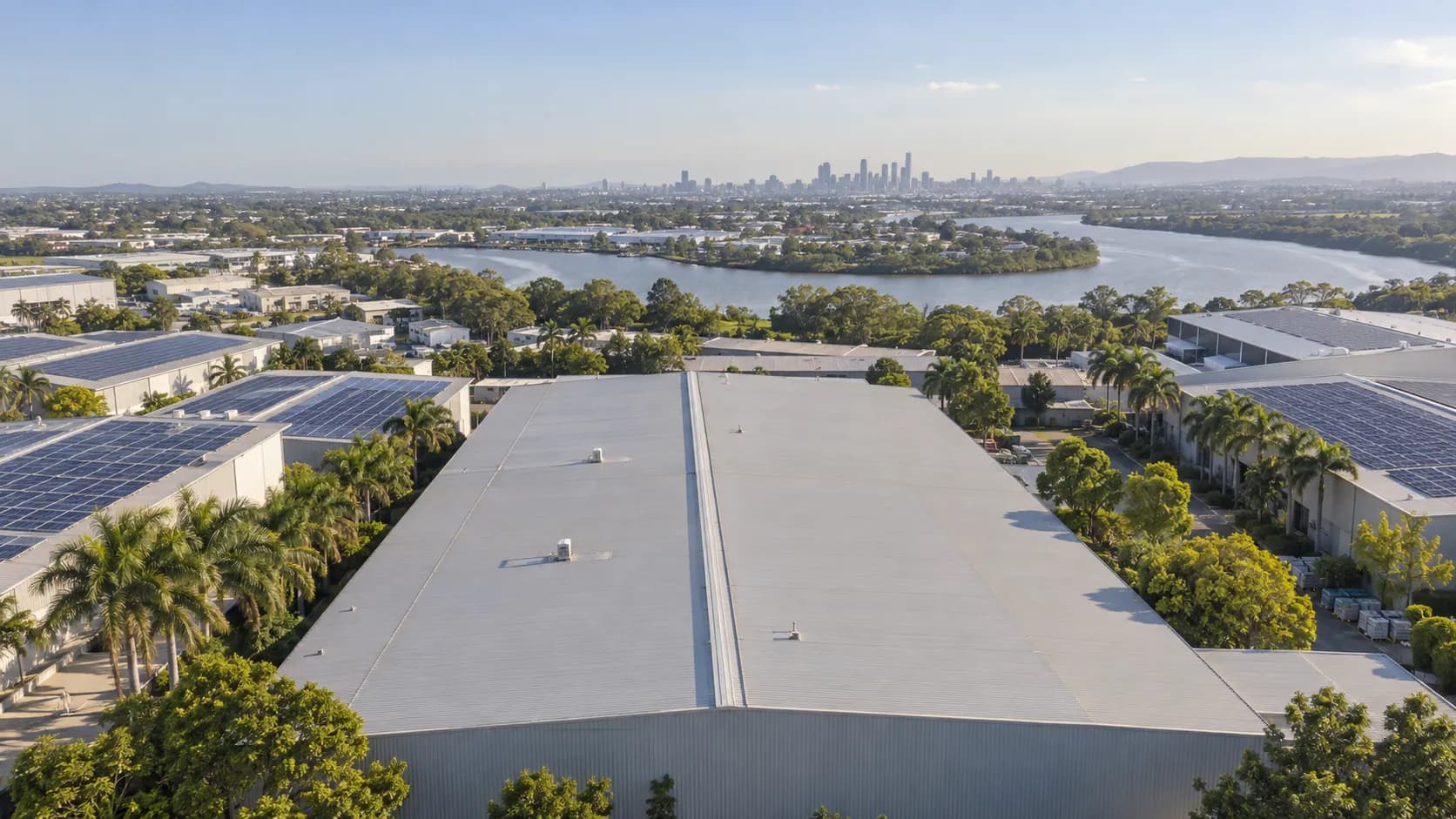
Yes, solar pays on a Brisbane warehouse about as well as anywhere in Australia: the sun is strong, the load runs in daylight, and the roof is never the limit. What's different in Brisbane is simplicity and heat. There is one network, so there is no boundary to check. And the summer heat that makes a big distribution centre's cool rooms and air conditioning work hardest also cuts panel output on the hottest afternoons, which a proper proposal allows for. The general case, and what a five-day week does to the sums, is on solar for warehouses.
| Quick facts | Warehouse solar in Brisbane |
|---|---|
| Distributor | Energex (all of south-east Queensland) |
| STC zone | Zone 3, rating 1.382 |
| State help | No rebate. Federal STC discount only |
| Share of solar used on site | about 78% on six days, about 65% on five |
| What to send | one recent bill; we get the interval data from it |
What's different in Brisbane?
1. One network for the whole south-east
Brisbane's sheds cluster in the south-west, Richlands, Wacol, Larapinta and Berrinba, out to the Yatala corridor on the way to the Gold Coast, and in the east around the Port of Brisbane, Lytton and Hemmant. Every one of them is on Energex. Ergon Energy only takes over in regional Queensland, so a Toowoomba or Rockhampton site is checked separately.
- Up to about 30kW: a standard connection.
- Around 100kW: above Energex's standard threshold a site moves to a negotiated connection with an export assessment. Allow weeks for it.
- Above 100kW: a negotiated connection with an export limit set per site. On the port and the south-west estates, where many large roofs already carry solar, caps are common. A warehouse sized to its weekday load is rarely troubled; one sized to the roof usually is.
The Brisbane commercial solar page has more on Energex.
2. STC zone 3
Brisbane is STC zone 3, rating 1.382. A 100kW system installed in 2026 earns 100 × 1.382 × 5 = 691 certificates, rounded down, about 17% more than the same system in Melbourne. Since 1 October 2026 the discount covers eligible systems up to 1MW, which brings the largest distribution centres inside the upfront scheme. The zone table is on the Clean Energy Regulator's site.
3. No state rebate
Queensland has no standing rebate for commercial solar. The federal STC discount does the work, and it is worth more here than in Melbourne because of the zone rating. Feed-in rates in south-east Queensland are set by retailers, not the government, and for a business they are usually low enough that the system should be sized to the site's own daytime load first. The current list of Queensland business programs is on energy.gov.au.
4. Strong sun, and heat that cuts output
About 1,450 kWh per kW a year, behind only Perth among the cities on this site. The catch is heat: panels lose output as they get hotter, and a flat metal roof in Richlands in February is hot. A good proposal uses a yield that allows for it rather than a spec-sheet headline. On the load side, Brisbane's summer is when cool rooms, dock-door air curtains and office air conditioning peak, which is also when the panels make the most, so self-use stays high.
A worked example for a Brisbane warehouse
Here is a worked example with made-up figures. These are example figures, not our prices or a real site. It is the same example as the warehouse row on our commercial solar cost page, so the two can be checked against each other.
- A 100kW system in Brisbane, assumed to make about 1,450 kWh per kW a year, so about 145,000 kWh a year.
- The warehouse runs six days and uses about 78% of the solar, 113,100 kWh. The other 31,900 kWh goes to the grid on Sundays and at the midday peak.
- At $0.28 for each kWh it no longer buys: 113,100 × $0.28 = $31,668. At $0.05 for exports: 31,900 × $0.05 = $1,595.
- Yearly saving $33,263. At an example price of $73,000 after the STC discount, that pays back in about 2.2 years.
Close the same site on Saturdays and self-use drops to about 65%: 94,250 kWh × $0.28 = $26,390, plus 50,750 kWh × $0.05 = $2,538, which is $28,928 a year and about 2.5 years. At $0.20 a kWh, which a large site on a demand tariff often pays, the six-day saving falls to about $24,200 and the payback stretches to about 3 years. The rate is on your bill, and it is the one figure a quote should never guess.
What to send
Just one recent electricity bill, every page. Using the meter number on it, we get your interval data, which shows the weekday load, the weekend gap and the demand charge. You don't need to request anything from your retailer.
Mention the shift pattern, the number of forklift chargers, any cool room and whether you lease the building. Send a bill and an accredited installer prepares a costed proposal. Already have a quote? Compare it line by line with our checklist, including whether the yield allows for Brisbane heat and whether an export limit is stated.