In short
- A Sydney factory running day shifts should expect a commercial solar payback of around two to two and a half years in 2026, with the shift pattern setting most of the answer.
- Which distributor your site sits on, Ausgrid or Endeavour Energy, changes the connection process and the export limit, so we check the address first.
- New South Wales has no solar rebate, but its Peak Demand Reduction Scheme discounts batteries, which matters for a factory with a sharp start-up peak.
For a Sydney manufacturer, commercial solar in 2026 pays back in roughly two to two and a half years on a weekday-shift site, and faster on two shifts. The price per kW is much the same across the city; what differs is the network, the export limit and the demand tariff you are on. This page covers what is specific to Sydney. The shift-pattern sums, the 1 MW STC change and the tax position are on solar for manufacturing, and the city as a whole is on commercial solar Sydney.
| Quick facts | Manufacturing solar in Sydney |
|---|---|
| Networks | Ausgrid (CBD, inner, north, east) or Endeavour Energy (south-west, outer west) |
| STC zone | Zone 3, rating 1.382 |
| State incentive | None for solar; Peak Demand Reduction Scheme for batteries |
| Example payback | 2.2 to 2.5 years at 100kW |
| What to send | one recent bill; we get the interval data from it |
What's different in Sydney
1. Two distributors, two sets of rules
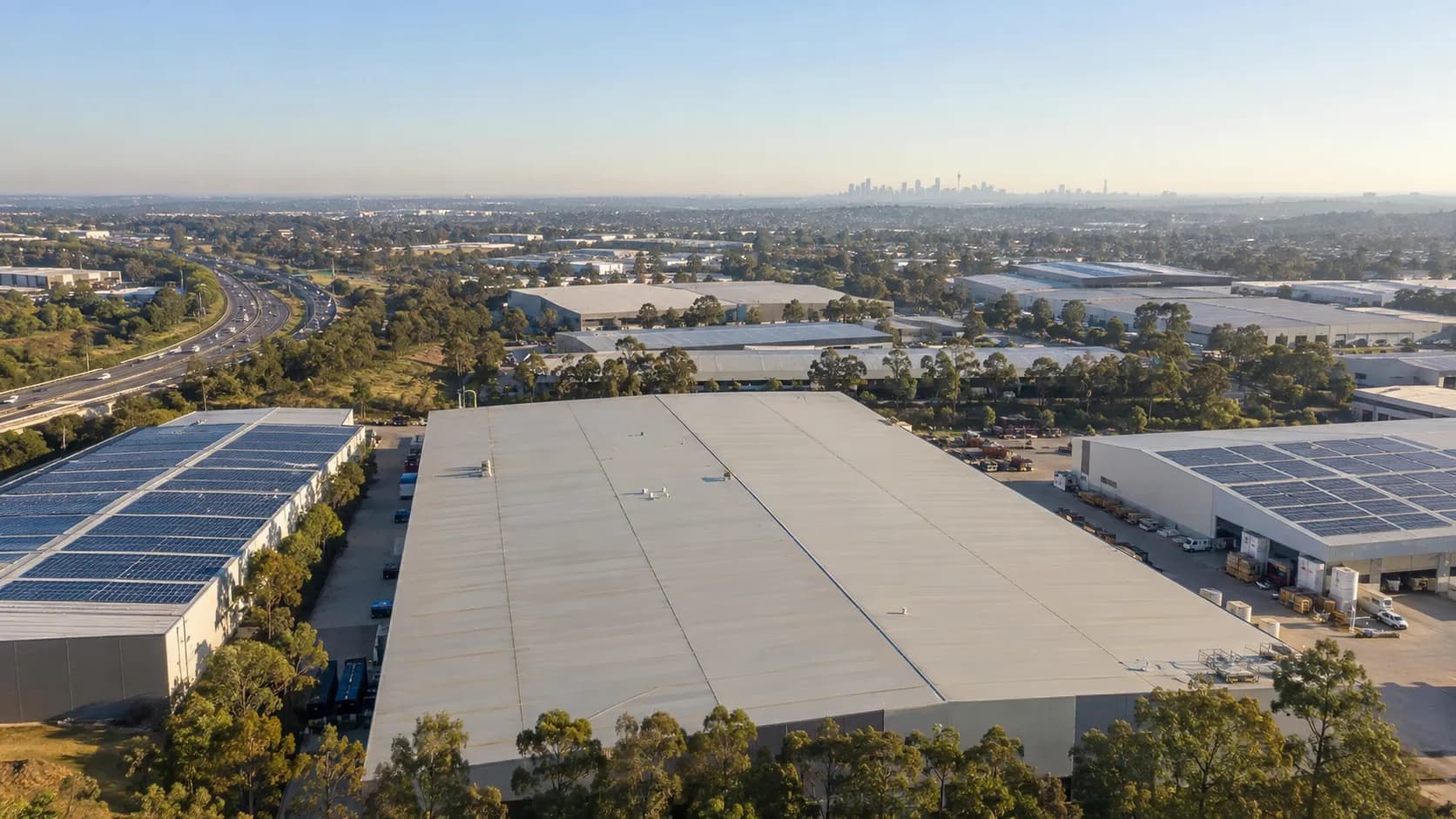
Sydney is split between two networks, and the boundary runs through the metro area. Ausgrid covers the CBD, the inner suburbs, the north and the east. Endeavour Energy covers the south-west and the outer west, which is where most of Sydney's manufacturing floor space sits: Smithfield, Wetherill Park, Erskine Park, Eastern Creek, Minto and Ingleburn. Essential Energy takes over beyond the metro.
Each distributor sets its own threshold for where a system moves from a simple connection to a full application with an export assessment, and its own export limits on constrained feeders. The thresholds and the current limits are the first thing we confirm for a Sydney address. What that means for a factory:
- Up to about 30kW on most feeders is a routine connection on either network, though the exact figure depends on the distributor.
- Around 100kW is a full application with a technical assessment on both networks. Allow for the timeline in the project plan, and expect the proposal to say who lodges it and what it costs.
- Above 100kW the assessment is more detailed and export limiting is common. Since 1 October 2026 a system between 100kW and 1MW can take the upfront STC discount (see the mid-scale rules), so a larger western Sydney roof is worth a fresh look, but the export limit must be designed in before the system is sized.
2. The STC zone: Zone 3
Sydney postcodes sit in STC Zone 3, with a rating of 1.382. For a 100kW system installed in 2026 that is 100 × 1.382 × 5 = 691 certificates, a bigger upfront discount than the same system in Melbourne (Zone 4) earns see the postcode zone table on the Clean Energy Regulator page.
3. No solar rebate, but a battery scheme
New South Wales has no rebate for commercial solar panels. The federal STC discount is the only upfront reduction. What New South Wales has, and no other state matches, is the Peak Demand Reduction Scheme, which gives businesses an upfront discount on batteries from 20 kWh up to 30 MWh, larger when new solar goes in within 90 days (batteries for businesses). For a factory whose monthly peak is set at 6am start-up, when the compressors, motors and lighting come on together, a battery can do more for the demand charge than the panels do. We run the solar case and the battery case separately and show both.
4. Where Sydney's factories are, and what they draw
General knowledge, not a measurement: Sydney's manufacturing is concentrated in the west and south-west, on Endeavour Energy, with pockets of food, pharmaceutical and light engineering in the inner west and on the Ausgrid side of the boundary. Most sites are three-phase with a demand charge on the bill, often on a network tariff with a peak window in the late afternoon and early evening. A one-shift site that finishes at 3.30pm uses almost none of its power in that window, so solar covers the daytime draw well but leaves the demand charge alone. The interval data from your meter shows which it is. See demand charges.
What payback should a Sydney factory expect?
Here is a worked example with example figures. They are not our prices and not a real site.
A 100kW system in Sydney is assumed to make about 1,380 kWh per kW a year, so 138,000 kWh in total. Each kWh the factory uses itself saves $0.28. Each kWh sent to the grid earns $0.05. The example price is $73,000 after the STC discount, the figure used on commercial solar cost.
| Shift pattern | Solar used on site | Saved on purchases | Earned on exports | Yearly saving | Years to pay back |
|---|---|---|---|---|---|
| One weekday day shift, closed weekends | 70% | $27,048 | $2,070 | $29,118 | 2.5 |
| Two shifts, six days a week | 85% | $32,844 | $1,035 | $33,879 | 2.2 |
The sums: 138,000 kWh × 70% = 96,600 kWh used on site × $0.28 = $27,048, plus 41,400 kWh exported × $0.05 = $2,070. Total $29,118 a year, and $73,000 ÷ $29,118 = 2.5 years. The second row works the same way at 85%.
These sums leave out demand charges, the slow wear of panels and future price changes. The same table by site type is on commercial solar cost, and the full shift-pattern table is on solar for manufacturing.
What to send for a Sydney manufacturing proposal
Just one recent electricity bill, with every page. The pages after the amount owing carry your tariff, your demand charge and your meter number. We use the meter number to get your interval data ourselves, so there is nothing to request from your retailer. We also read the address against the Ausgrid and Endeavour Energy boundary before we size anything, because it changes the process. From there you get a costed proposal with every assumption shown.
If you already have a quote, compare it line by line with our checklist. Otherwise, send your bill.
Questions from Sydney manufacturers
Does it matter whether my factory is on Ausgrid or Endeavour Energy? Yes. The two distributors set their own thresholds for where a connection moves from a simple notification to a full application, and their own export limits on constrained feeders. A site in Wetherill Park and a site in Alexandria go through different processes with different timelines. We confirm which network an address sits on before sizing, and the proposal names the process, who lodges it and any fees.
Is a Sydney factory better off with solar or a battery? It depends on when your monthly peak falls. If your demand charge is set at start-up, when the plant comes on together before the sun is up, solar does little for it and a battery can do a lot, and the Peak Demand Reduction Scheme discounts that battery. If your peak falls in the middle of a sunny day, solar lowers it on its own. Your interval data settles it, and we show the solar case and the battery case as separate sums rather than one blended figure.
How much does the STC discount cut from a 100kW system in Sydney? Sydney is in STC Zone 3. A 100kW system installed in 2026 earns 100 × 1.382 × 5 = 691 certificates. Their value moves with the certificate market, so the discount on the quote should show the certificate count and the price assumed. A quote that shows one "after rebate" figure with no working cannot be checked.
Can a western Sydney factory go above 100kW now? Yes. From 1 October 2026 a system between 100kW and 1MW can create STCs instead of large-scale certificates, which removes the paperwork that used to make 110kW a worse deal than 99kW. The limit counts all solar on the site, and the Clean Energy Regulator opens applications from mid to late November 2026. The export limit on your feeder, not the certificates, is what usually caps the size on an industrial estate.