In short
- A Sydney warehouse running day shifts uses about 75–80% of its solar, so the return is good even though Sydney roofs make less per kW than Brisbane or Perth.
- Most of Sydney's logistics belt is on Endeavour Energy, not Ausgrid. The two networks have different connection rules and export caps, and the cap, not the roof, decides the size.
- New South Wales has no solar rebate, but it has a business battery discount that can suit a site with a sharp afternoon peak.
Yes, solar pays on most Sydney warehouses, because the load runs in daylight and the roof is big enough for whatever the load needs. What's different in Sydney is where the limit comes from: the network's export cap. A distribution centre at Eastern Creek can fit far more panels than it can use or export, so the right size is set by the weekday load and the cap, not by the roof. The general case, including what a five-day week does to the sums, is on solar for warehouses.
| Quick facts | Warehouse solar in Sydney |
|---|---|
| Distributor | Endeavour Energy (west, south-west) or Ausgrid (inner, north, east) |
| STC zone | Zone 3, rating 1.382 |
| State help | No solar rebate. Battery discount through the Peak Demand Reduction Scheme |
| Share of solar used on site | about 78% on six days, about 65% on five |
| What to send | one recent bill; we get the interval data from it |
What's different in Sydney?
1. The logistics belt is mostly Endeavour Energy
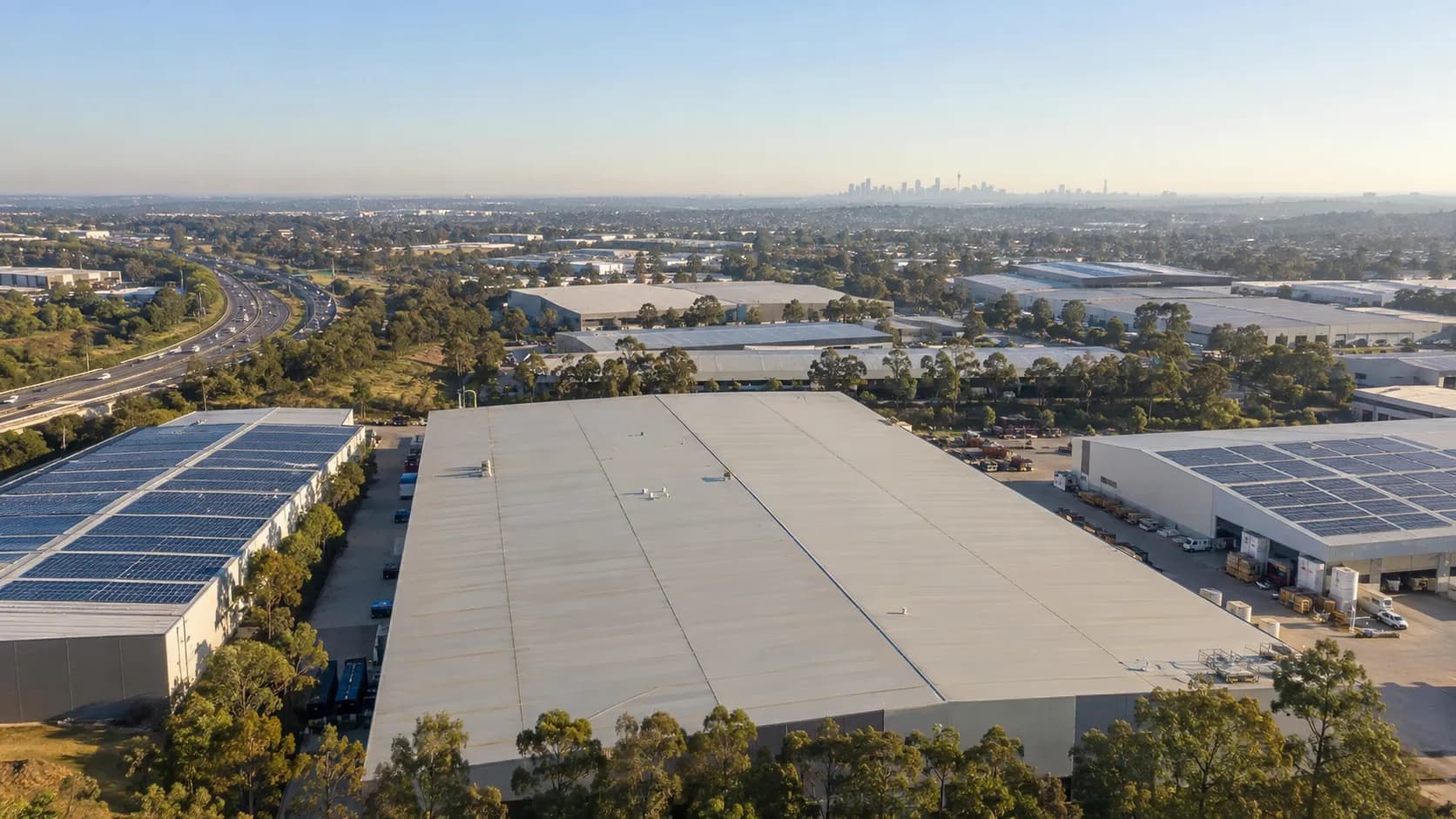
Sydney's big sheds sit in the west and south-west: Eastern Creek, Erskine Park, Kemps Creek, Prestons, Moorebank and the new estates around the airport at Badgerys Creek. Nearly all of that is Endeavour Energy territory. Ausgrid covers the older industrial pockets closer in: Botany and Banksmeadow, Silverwater, Homebush and Alexandria. The boundary runs through the metro, and the two networks do not share thresholds or export rules.
- Up to about 30kW: both networks handle a small system under a simpler process. Few warehouses stop there.
- Around 100kW: a full connection application with an export assessment on either network. Allow weeks for it and plan the install date around it.
- Above 100kW: a negotiated connection, and on the big new estates an export cap is common because dozens of sheds on one feeder all want to export at midday. A warehouse sized to its weekday load is rarely troubled by it. One sized to the roof usually is.
We check the address against the network boundary before quoting. The Sydney commercial solar page covers both networks.
2. STC zone 3
Sydney is STC zone 3, rating 1.382. With five years counted for a 2026 install, a 100kW system earns 100 × 1.382 × 5 = 691 certificates, rounded down. That is about 17% more than the same system in Melbourne, which is why a Sydney quote for identical equipment should come in cheaper after the discount. Since 1 October 2026 the discount covers eligible systems up to 1MW, so a large distribution centre no longer has to stop at 100kW to keep the upfront discount. The zone table is on the Clean Energy Regulator's site.
3. No solar rebate, but a battery discount
There is no NSW rebate on commercial solar panels. The STC discount is the only upfront reduction. NSW does have the Peak Demand Reduction Scheme, an upfront discount on business batteries from 20 kWh to 30 MWh, larger when new solar goes in within 90 days. For a warehouse whose demand peak is a bank of forklift chargers starting at shift change, or dock-door air curtains on a hot afternoon, a battery that trims the peak can pay. Our commercial solar batteries page shows how to tell.
4. A lower yield than Brisbane, and a steady load
A Sydney roof makes about 1,380 kWh per kW a year, below Brisbane's 1,450 and Perth's 1,600, because of cloudier, more humid summers. So a Sydney system is sized a little larger for the same output. The load side helps: lighting, conveyors and chargers run steadily all day, and a cool room or two adds a base load that never drops.
A worked example for a Sydney warehouse
Here is a worked example with made-up figures. These are example figures, not our prices or a real site. The price is the one our commercial solar cost page uses for a 100kW system.
- A 100kW system in Sydney, assumed to make about 1,380 kWh per kW a year, so about 138,000 kWh a year.
- The warehouse runs six days. It uses about 78% of the solar, 107,640 kWh. The other 30,360 kWh goes to the grid on Sundays and at the midday peak.
- At $0.28 for each kWh it no longer buys: 107,640 × $0.28 = $30,139. At $0.05 for exports: 30,360 × $0.05 = $1,518.
- Yearly saving $31,657. At an example price of $73,000 after the STC discount, that pays back in about 2.3 years.
Close the same site on Saturdays and self-use drops to about 65%: 89,700 kWh × $0.28 = $25,116, plus 48,300 kWh × $0.05 = $2,415, which is $27,531 a year and about 2.7 years. If Endeavour Energy caps exports to zero on that feeder, the export line disappears and the five-day saving falls to about $25,100, so a quote that assumed full export on a capped feeder is nearly half a year out.
What to send
Just one recent electricity bill, every page. Using the meter number on it, we get your interval data, which shows the weekday load, the weekend gap and the demand charge. You don't need to request anything from your retailer.
If you know them, mention the shift pattern, the number of forklift chargers and whether you lease the building. Send a bill and an accredited installer prepares a costed proposal sized to how the site runs. Already have a quote? Compare it line by line with our checklist, including whether it names the right distributor and an export limit.